The giant stone blocks of the Alexandria Lighthouse lifted from the sea bed
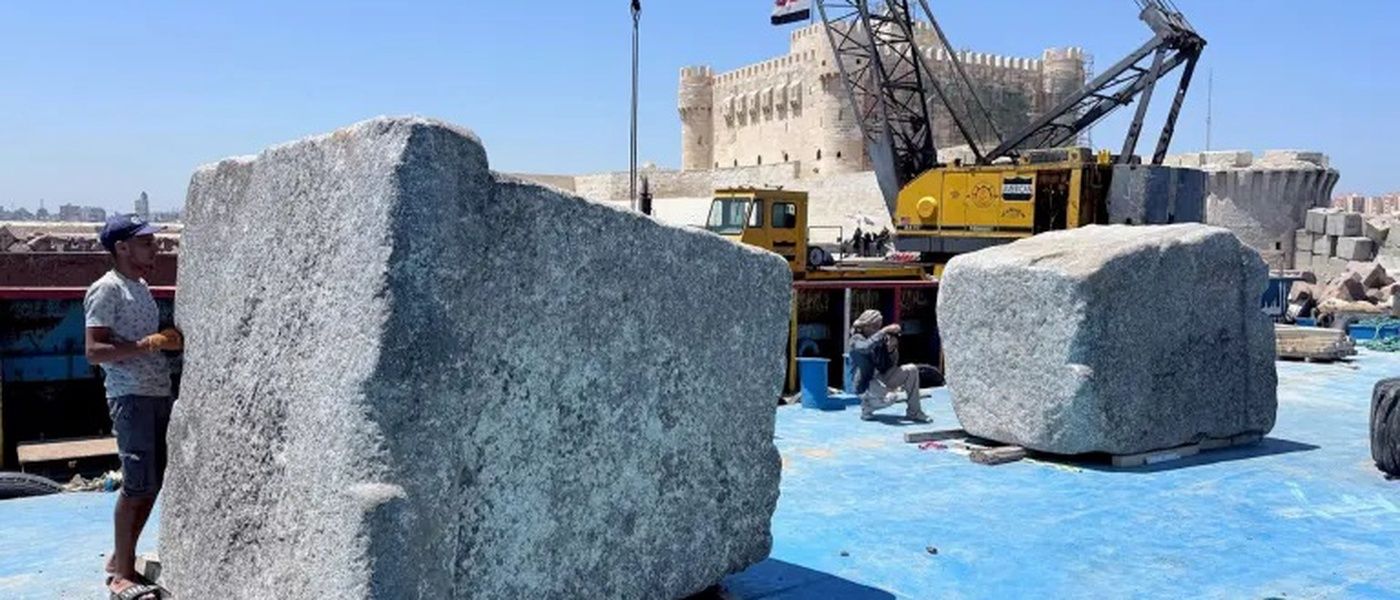
According to a press release from La Fondation Dassault Systèmes, which has supported the project for the past three years, dated June 24, 'Among the stone blocks, there are monumental door lintels and jambs weighing 70 to 80 tons, including an entrance gate (pylon) built in the Egyptian style during the Hellenistic period, thresholds, large foundation slabs, and parts of a previously unknown monument. This research (PHAROS) helps to fill the gaps resulting from the extremely fragmented archaeological remains due to the use of the lighthouse as a quarry for building materials from the time it ceased operations in 1303 until the construction of the Citadel of Qaitbay in 1477'.
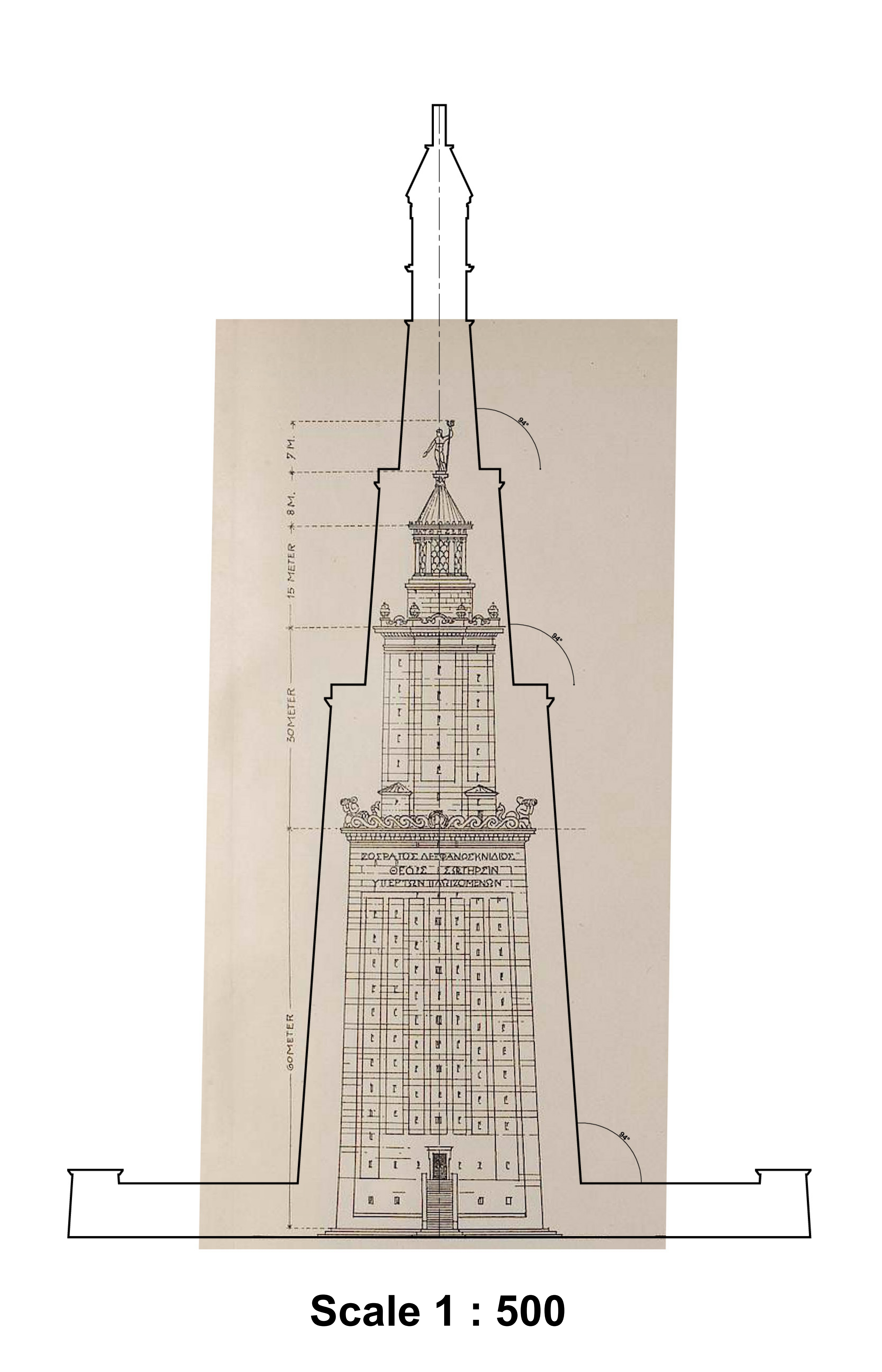
The Lighthouse of Alexandria, rumored to have a square base, an octagonal middle section, and a cylindrical top, was one of the Seven Wonders of the Ancient World. Built in the third century BC by Ptolemy I, ruler of Egypt, and reaching a height of 330 feet (100 meters), the lighthouse was one of the tallest man-made structures in the world for hundreds of years until it was destroyed by earthquakes.
The excavation and underwater research were conducted under the scientific supervision of Isabelle Hairy, an archaeologist and architect from the French National Center for Scientific Research, and under the authority of the Egyptian Ministry of Tourism and Antiquities. Each block will be scanned and examined before being added to a collection of over 100 blocks digitized over the last decade, with the aim of creating a virtual model of the lighthouse.
PHAROS project encompasses research conducted by historians, numismatists*, and archaeologists, which involves collecting "old depictions and descriptions of the lighthouse" from the late fourth century BC until its destruction in the early 15th century, in addition to excavation work.PHAROS project encompasses research conducted by historians, numismatists*, and archaeologists, which involves collecting "old depictions and descriptions of the lighthouse" from the late fourth century BC until its destruction in the early 15th century, in addition to excavation work.
A French documentary production company, GEDEON Programmes, financed the barge and crane used to lift the lighthouse blocks and filmed the excavation for a 90-minute documentary to be broadcast on French television. GEDEON Programmes had helped co-finance the salvage mission in which French archaeologist Jean-Yves Empereur of the Centre d’Études Alexandrines first discovered the underwater remains of the lighthouse in 1995, which resulted in the documentary company producing the acclaimed film, The Seventh Wonder of the World. (Source: ARTnews/Karen K. Ho Photo: Two of the 22 large stone blocks from the Lighthouse of Alexandria. Courtesy GEDEON Programmes / CEAlex)
Pharos, which gives its name to the PHAROS project
Pharos was a small island located on the western edge of the Nile Delta. In 332 BC, Alexander the Great founded the city of Alexandria on an isthmus opposite Pharos. Alexandria and Pharos were later connected by a mole spanning more than 1,200 metres (0.75 miles), which was called the Heptastadion ("seven stadia"—a stadion was a Greek unit of length measuring approximately 180 m).
The east side of the mole became the Great Harbour, now an open bay; on the west side lay the port of Eunostos, with its inner basin Kibotos now vastly enlarged to form the modern harbour. Today's city development between the present Grand Square and the modern Ras el-Tin quarter is built on the silt which gradually widened and obliterated this mole. The Ras el-Tin promontory, where Ras el-Tin Palace was built in the 19th century, represents all that is left of the island of Pharos, the site of the lighthouse at its eastern point having been weathered away by the sea.The east side of the mole became the Great Harbour, now an open bay; on the west side lay the port of Eunostos, with its inner basin Kibotos now vastly enlarged to form the modern harbour. Today's city development between the present Grand Square and the modern Ras el-Tin quarter is built on the silt which gradually widened and obliterated this mole. The Ras el-Tin promontory, where Ras el-Tin Palace was built in the 19th century, represents all that is left of the island of Pharos, the site of the lighthouse at its eastern point having been weathered away by the sea.
The Lighthouse of Alexandria and the origin of the stones used in its construction
The Lighthouse of Alexandria, sometimes called the Pharos of Alexandria was constructed in the third century BC. After Alexander the Great died, Ptolemy the First (Ptolemy I Soter) declared himself king in 305 BC and commissioned its construction shortly thereafter. The building was finished during the reign of his son, Ptolemy II Philadelphus, and took twelve years to complete at a total cost of 800 talents of silver. The light was produced by a furnace at the top, and the tower was said to have been built mostly with solid blocks of limestone and granite. The blocks of sandstone and limestone used in the construction of the lighthouse have been scientifically analysed to discover where they originated, with mineralogical and chemical analysis pointing to the Wadi Hammamat quarries, in the desert to the east of Alexandria.
*TN: The scientific discipline that deals with and examines coins and paper money is called numismatics. People who are involved with numismatics are called numismatists.
(1) Akarish, Adel & Dessandier, David. (2011). Characterization and Source of Sedimentary Rocks of the Alexandria Lighthouse Archaeological Objects, Egypt. Journal of Applied Sciences. 11. 10.3923/jas.2011.2513.2524
Drawing: A size comparison between a 1909 (inner shape) and a 2006 study (outer shape) of the building (Source: Wikipedia, Shenouda, 2013)
Recent News
Street unearthed in Aspendos
Restoration of Haydarpaşa Station continues
#Haydarpaşa Train Station #Lefke Stone (sandstone) #Hereke Granite
Stoneline Publications’ third book: SELİMİYE
Sümela Monastery reopened to visitors
International Mustafa V. Koç Underwater Archaeology Symposium
#Prokonnesos quarry #Verde Antico #Marmor Docimium, Pavonazzetto, Afyon Violet
The Granikos Battlefield has been placed under protection
#Marmara marble #Prokonnesos marble #Granikos Battle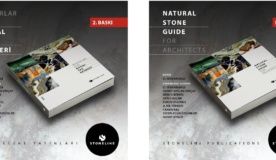
The Second Edition of Mimarlar İçin Doğal Taş Rehberi and the English Edition, Natural Stone Guide for Architects, Have Been Published
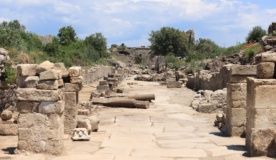
One of the main streets of Ancient Side has been unearthed
#conglomerate #Side Ancient City #Feriştah Alanyalı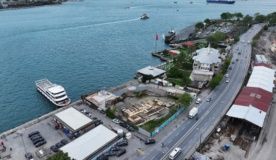
The historic Yalı Pavilion is to be reconstructed
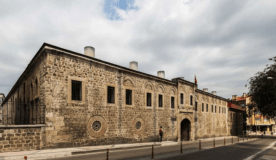
The theme of the Edirne Biennial: Bridges