The restoration of Hagia Sophia in the light of scientific methods
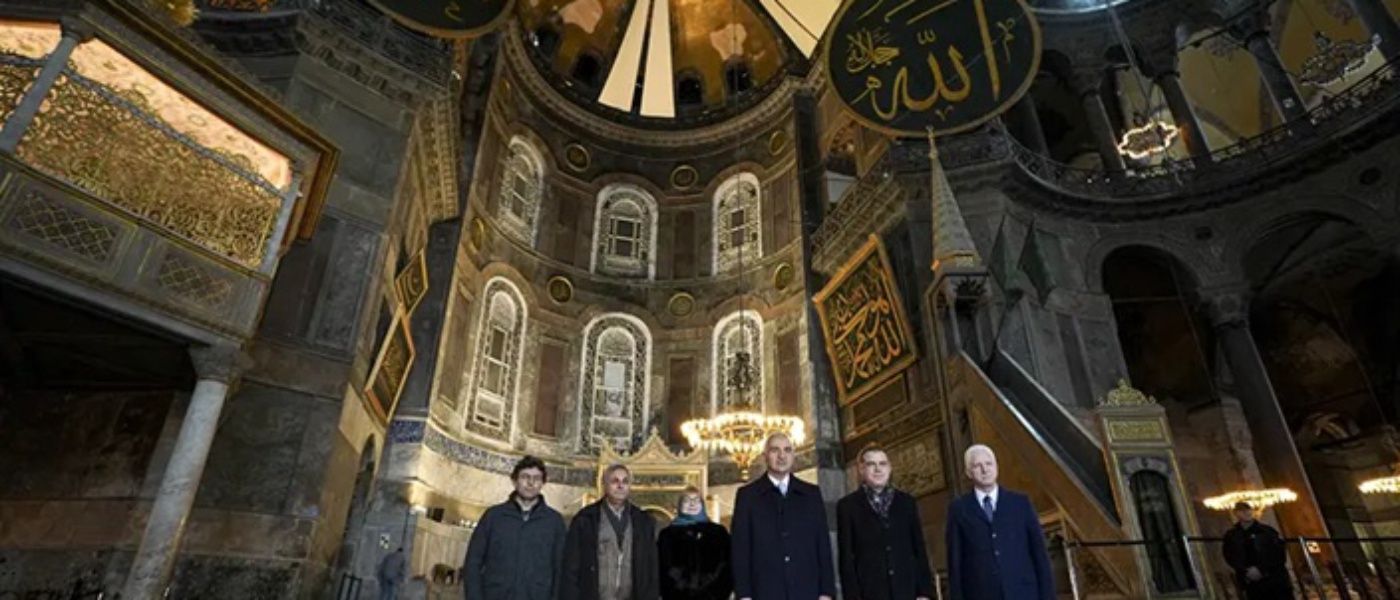
The Minister of Culture and Tourism, Mehmet Nuri Ersoy, together with the Governor of Istanbul, Davut Gül, and members of the Scientific Committee, inspected the extensive restoration work being carried out at the Hagia Sophia Mosque and the Sultanahmet Mosque. Emphasising that the processes are being carried out under the supervision of scientific committees using transparent and scientific methods, Ersoy announced that the work at Sultanahmet has been completed, whilst the multi-layered restoration at Hagia Sophia is continuing in line with the planned schedule.
Work carried out as part of the comprehensive restoration Project
Ersoy stated that, as part of the work being carried out at the Hagia Sophia Mosque, scaffolding covering approximately 11,000 square metres had been erected on the north, east and south façades and the minarets; that analyses had revealed the presence of cement-based plaster on the north and east façades; that this plaster had been meticulously removed from an area of approximately 2,800 square metres; He added that, on the surfaces where scraping had been completed, biological growth removal and desalination processes were also carried out, whilst mechanical cleaning work on the marble surfaces was continuing.
Ersoy went on to say: ‘In order to ensure that the structure can continue to bring all of humanity together under its dome for centuries to come, the most comprehensive restoration project in its history has been launched, with the aim of preserving the building, maintaining the original materials and ensuring its long-term structural safety.
Through analyses carried out by our central laboratory, we identified findings dating to the Early Byzantine, Late-Middle Byzantine and Ottoman periods in the joint and masonry mortars. With the approval of our scientific committee, we commissioned the production of handmade bricks appropriate to the Byzantine and Ottoman periods and began using these in the restoration work. Of course, we also carried out ground-penetrating radar scans and digital modelling studies to determine the building’s reinforcement requirements. Based on the data revealed by this study, which covered an area of 5,200 square metres, reinforcement projects were prepared and approved'.
Ersoy reported that, as part of the structural analysis, a controlled dismantling had been carried out on the north-east minaret down to the level of the balcony; he emphasised that the dismantled stones had been documented individually and that those in a usable condition had been restored using traditional methods and reinstalled in their original positions. Minister Ersoy stated that the re-masonry work on the minaret’s body, muqarnas, honeycomb and step sections had been completed; that the balcony flooring, balustrades and finial fabrication had been carried out; that the restoration of the copper finial and the gold leaf gilding work had been finalised; that surface cleaning had been completed; and that work on the dome cladding and leadwork was still ongoing.
Ersoy emphasised that reinforcement work using stainless steel plates and rods was being carried out in parallel with the structural design, adding that inappropriate cement-based interventions had been removed, stone repairs had been carried out, and joint and cosmetic repair work was ongoing.
Minister Ersoy made the following remarks regarding the work being carried out on the dome of Hagia Sophia: 'We are taking every step in this project with this awareness. Whilst removing the lead covering from the dome, we commissioned and obtained approval for temporary steel roof and platform designs to ensure that the mosaics and the structure inside the building are not affected by weather conditions.
We have also completed the installation of the steel platform inside the building. Before installing this 43.5-metre-high system, we carried out ground tests, load analyses, ground-penetrating radar scans, and vibration tests. Following the positive reports resulting from these, we proceeded with the installation. Moving on to the sanctuary area, we carefully documented and removed the existing marble flooring. We then installed a multi-layered temporary flooring system that ensures both load distribution and floor protection. The steel platform fabrication has also been completed, and a lift and staircase system has been installed to provide access to the platform.'
The mosque’s underground tunnels and the underground burial structure known as the hypogeum
Referring to the surveys and cleaning work being carried out on the mosque’s underground tunnels and the underground burial structure known as the hypogeum, Ersoy noted that the work in the Western Garden and Northern Facade Vezir Garden areas was being carried out using scientific methods and by specialist teams. Minister Ersoy stated that they had carried out cleaning and documentation work in Spaces 1, 2, and 3 in the Western Garden, as well as in the tunnels connected to these areas, and shared the following:
'At Site 1, we removed almost 112 tonnes of fill soil during the clearance work we carried out between 31 January and 10 March 2025. At Site 2, we began excavations on 12 March 2025 and removed approximately 522 tonnes of fill soil. As of this month (February 2026), we have already cleared 32 tonnes of fill soil in the work we have commenced at Site 3.
Through the work carried out in the West Garden, we have also documented seven tunnel lines, each hundreds of metres long, associated with these sites. To date, we have cleared 1,068 tonnes of fill soil from these tunnels. We carried out clearance work in the area at Vezir Bahçe, assessed as an underground burial structure, between 2 June and 13 August 2025. During this process, we removed 102 tonnes of fill soil from this specific area. Here, there is a main corridor flanked on either side by symmetrical burial chambers.
The primary aim of all these works is to reveal the building’s historical layers, identify existing risks, and safeguard the cultural heritage. To this end, we are continuing the design and intervention works together in both the underground tunnels and the hypogeum area. These works, which we are carrying out with the approval of the Scientific Committee, are being conducted alongside cleaning, documentation, and structural measures’.
Source and photo: AA
Recent News
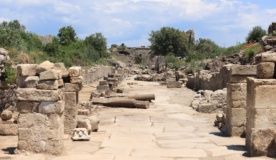
Street unearthed in Aspendos
Restoration of Haydarpaşa Station continues
#Haydarpaşa Train Station #Lefke Stone (sandstone) #Hereke Granite
Stoneline Publications’ third book: SELİMİYE
Sümela Monastery reopened to visitors
International Mustafa V. Koç Underwater Archaeology Symposium
#Prokonnesos quarry #Verde Antico #Marmor Docimium, Pavonazzetto, Afyon Violet
The Granikos Battlefield has been placed under protection
#Marmara marble #Prokonnesos marble #Granikos Battle
The Second Edition of Mimarlar İçin Doğal Taş Rehberi and the English Edition, Natural Stone Guide for Architects, Have Been Published
One of the main streets of Ancient Side has been unearthed
#conglomerate #Side Ancient City #Feriştah Alanyalı
The historic Yalı Pavilion is to be reconstructed
The theme of the Edirne Biennial: Bridges