Item 1 of 1
Properties
Properties of the Stone
Additional Names
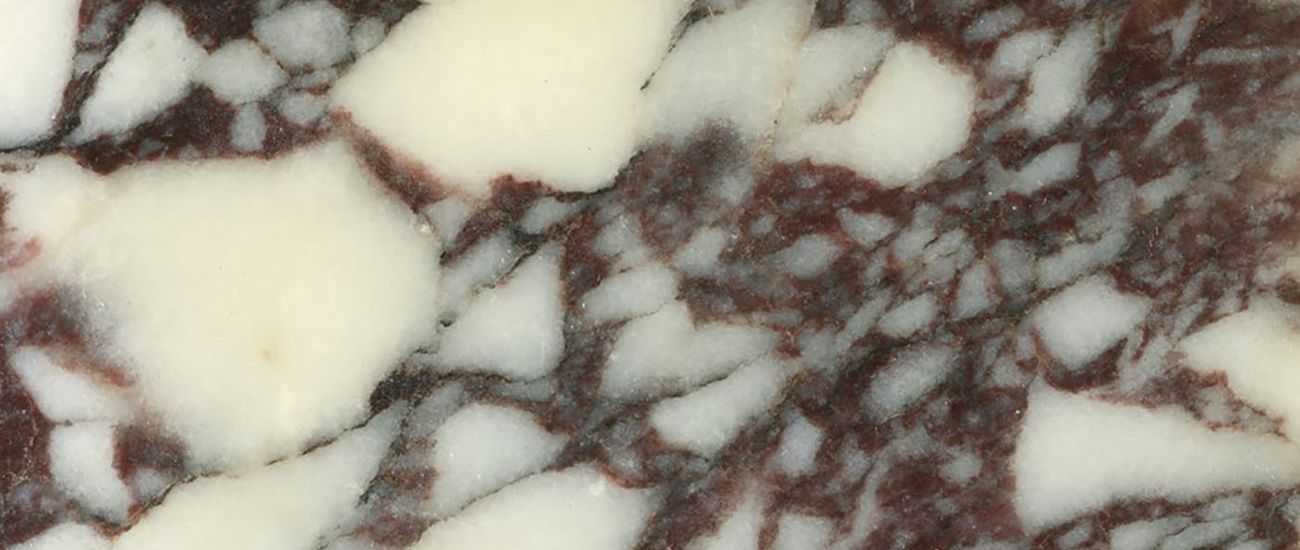
Marmor Docimium, Pavonazzetto, Afyon Violet
Color
White+Purple
Scientific Classification
Brecciated Marble
Commercial Classification
Marble
Quarry Site
Afyonkarahisar-Türkiye
Quarry State
Active
Quarry Site and Nomenclature
Afyon Marble, quarried since the Roman Empire, is still extracted from ancient and modern quarries in the Boğaz region of İscehisar district in Afyonkarahisar province. The most significant ancient quarry in the region is the Bacakale marble quarry*, known for producing the distinctive Afyon Violet marble. This marble was extensively used during Roman times, primarily sourced from quarries near the ancient city of Docimenium in Phrygia. Classified as a ‘Brecciated Marble,’ it was referred to as ‘Marmor Docimenium/Phrygium’ and later by Italian stonemasons as ‘Pavonazzetto.’
Varieties and Architectural Applications
Afyon Marble exhibits a range of colors, including white, gray, and purple/lavender. In antiquity, the most prized variety was the purple/lilac marble, which was extensively used. In addition to this type, other varieties produced in the region today include Afyon White, Afyon Sugar, Afyon Honey, Afyon Gray, and Tiger Skin.
Due to its malleability, polishability, and excellent block yield, Afyon Marble has been utilized in various applications since ancient times. These include slabs, tiles, interior and exterior cladding, flooring, souvenirs, and sculptures. The marble is especially prominent in architectural features such as arch and border stones, floor coverings, inscriptions, columns, and door and window sills.
Cultural and Architectural Significance
Afyon Marble was also used in ancient Greek baths and prominent sites such as the ancient city of Ephesus. The Basilica of St. Peter in the Vatican and the Pantheon Temple in Rome are among the notable structures featuring this marble. During the late Ottoman period, Afyon Marble was employed in Çırağan Palace. Following the foundation of the Republic of Türkiye, it was selected for the Turkish Grand National Assembly and the mausoleum of Mustafa Kemal Atatürk, Anıtkabir.
*Erguvanlı and Sayar, 1955, 1962.
_276x160.jpg)
_276x160.jpg)
_276x160.jpg)
_276x160.jpg)
_276x160.jpg)
_276x160.jpg)
_276x160.jpg)
_276x160.jpg)