Item 1 of 1
Properties
Properties of the Stone
Additional Names
Hexecontalithos, Breccia di Hereke
Color(s)
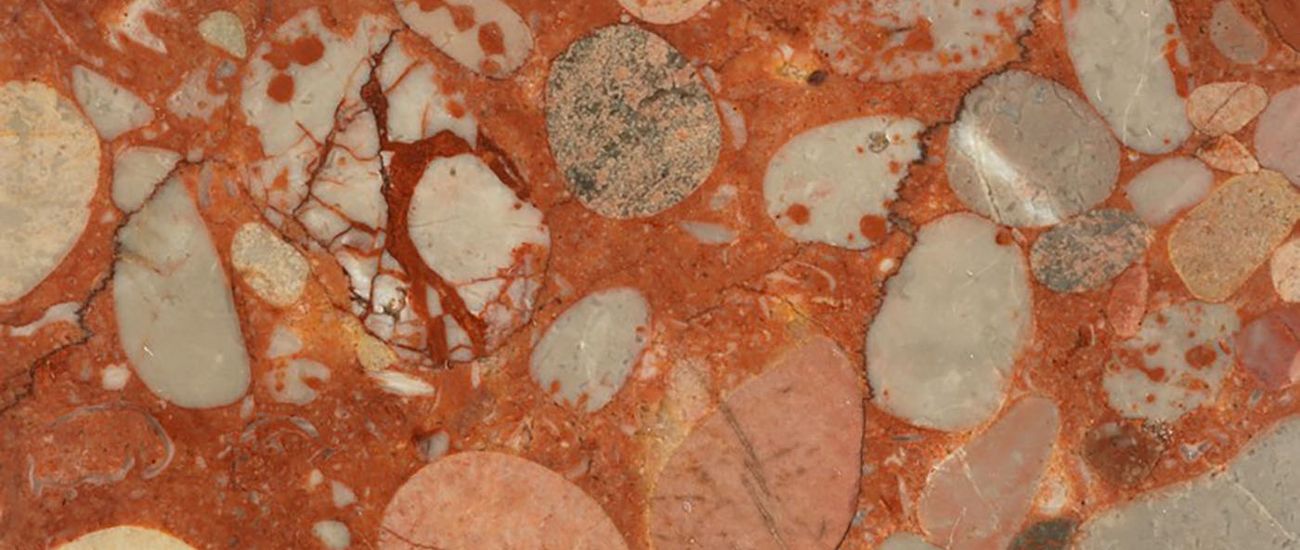
Beige+Grey+Red
Scientific Classification
Conglomerate
Commercial Classification
Marble
Quarry Site
Kocaeli-Türkiye
Quarry Status
Inactive
Quarry Site and Nomenclature
Hereke Puddingstone was extracted from ancient quarries in the area stretching from near the train station in Hereke, Kocaeli, to the Mağara Burnu in the east. The puddingstone quarried from these sites was transported to nearby Darıca port and shipped to construction sites throughout the Mediterranean.
The Ottomans referred to the stone as ‘mermer-i/seng-i surhi Darıca’ (Red Darıca Marble) for this reason.
The term ‘puddingstone,’ originating from British terminology, refers to a conglomerate rock formed by rounded pebbles of varying origins held together by natural cement. This name derives from its resemblance to a Christmas pudding.*
Technical Specifications
This natural stone is a sedimentary conglomerate composed mostly of rounded grains of gray, beige, and pink limestone and dolomitic limestone. The natural carbonate cement binding these grains varies in color from light gray to red, depending on the hematite (iron) content.
Usage Areas
Hereke Puddingstone was primarily used in both indoor and outdoor, particularly in arch and border stones, flooring, inscription surrounds, and for columns, as well as door and window frames. In Istanbul, throughout history, it was employed as a decorative element in significant historical landmark buildings and cultural heritage sites such as palaces, churches, mosques and their associated imaret complexes.
*Neuendorf et al., 2005.
_276x160.jpg)
_276x160.jpg)

_276x160.jpg)
_276x160.jpg)
_276x160.jpg)
_276x160.jpg)
_276x160.jpeg)

_276x160.jpg)
_276x160.jpg)
_276x160.jpg)